8.-11.10.2026
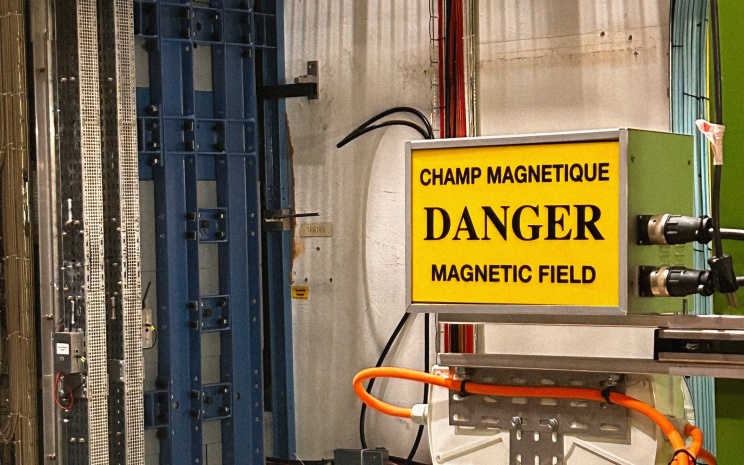
The microcosm and the macrocosm have always been directly connected, because the building blocks that make up our home planet, Earth, and ourselves were formed either shortly after the Big Bang or through nuclear fusion inside stars, and were then hurled out into space during supernova explosions. At CERN, exploring this relationship is at the centre of the work. That is where the world's largest particle accelerator is currently located; it is believed that this accelerator can recreate conditions similar to those that existed shortly after the Big Bang.
Since 2012, the outreach programme art@CMS/ORIGIN has been linking the scientific community around the CMS particle detector with artists, art students, and art teachers, to inspire as many people as possible for particle physics. As part of the course Interdisziplinäre Räume 2, a group of students from IEM – Institute for Electronic Music and Acoustics travelled in January 2026 to the SciArt Dialogue Week 2026 at CERN, organised by art@CMS/ORIGIN. Also on the trip was a student from Australia’s RMIT University. The experiences and insights gathered there formed the point of departure for the works now presented for the first time as part of the Supernova exhibition.
Artists: Joseph Böhm, Francesco Casanova, Cornelius Grömminger, I–A, Lain Iwakura, Joris Kindler, Pablo Knupfer, Gemma Lambourne, Artem Sivashenko, and Zlata Zhidkova.
Concept, project management: Anke Eckardt
Idea, concept, journalistic accompaniment: Susanna Niedermayr
Head of art@CMS/ORIGIN, CERN: Michael Hoch
With thanks to Lea Sonnek, Dominik Lekavski, University of Music and Performing Arts Graz.
Supernova
Supernova - Eröffnung
A project of the University of Music and Performing Arts Graz (Institute 11 Stage Design). In cooperation with ORF musikprotokoll, Volkskundemuseum am Paulustor, art@CMS/ORIGIN, CERN – European Organization for Nuclear Research (with the experiments ATLAS – A Toroidal LHC ApparatuS, ALICE – A Large Ion Collider Experiment, CMS – Compact Muon Solenoid, LHCb – Large Hadron Collider beauty, and IdeaSquare – Innovation Space at CERN), University of Graz (Department of Arts and Musicology and interdisciplinary core research area “Perception: Episteme, Aesthetics, Politics” at the Faculty of Humanities), HEPHY – Institute for High Energy Physics of the Austrian Academy of Sciences (Vienna), Florida State University, RMIT University, Österreichische Hochschüler_innenschaft (ÖH).