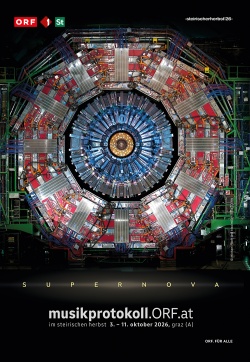
Supernova
3.10.‒11.10.
When we look up at the stars, we are looking into a mirror: we find the seemingly infinite depth of the universe within ourselves as well, because the elements that make up us and our fellow beings were created either shortly after the Big Bang or through nuclear fusions inside stars.
This year, ORF musikprotokoll embarks on a quest for origins. In numerous world premieres, the invited artists explore the connection between the microcosm and the macrocosm. The exhibition Supernova and the symposium Space, Time and Material: Trajectories between Art and Science — featuring lecturers, researchers, and students from the University of Music and Performing Arts Graz and the University of Graz — serve as crystallisation point. They were inspired by a field trip to the SciArt Dialogue Week 2026 at CERN.
The Supernova exhibition takes place at the Volkskundemuseum, which serves as a festival hub this year. In Worlds / Graz, Natasha Barrett, among others, searches for dark matter. The performance Das relativ wohltemperierte Klavier demonstrates that a piano can never be entirely unsettled — not even when it has been dismantled into its component parts.
The first concert evening takes place at Dom im Berg, where Marcus Schmickler and Chris Henschke, among others, try to get closer to quantum physics, and Elisabeth Schimana invites the audience on a journey into the sun. With S.E.T.I., the search for extraterrestrial intelligence becomes a means of introspection.
Various connections between the microcosm and the macrocosm can be found not only on a scientific and philosophical level but also on a societal and political one. What risks is an individual willing to take to have an impact on society? On several occasions, ORF musikprotokoll has drawn attention to the political prisoner Maria Kalesnikava. Following her release in December 2025, the Belarusian flutist and civil rights activist now performs with the RSO Vienna at Helmut List Halle.
Helmut List Halle is a second central venue. In Jennifer Walshe's multimedia performance THE GREATER NOISE, the universe shrinks to the size of the concert hall. The program also features performances by the ensembles Zeitfluss, PHACE, and Cantando Admont. Under the direction of Cantando Admont, more than 250 singers — professionals, young people, and amateurs — dedicate themselves to a musical deciphering of Leonardo da Vinci's sound puzzle, performing, among other works, Beat Furrer's choral cycle ENIGMA.
All this and much more awaits during this musikprotokoll week, which concludes with Alexander Chernyshkov's chamber opera Heute schrieb ich nix. This work was awarded the Johann-Joseph-Fux Prize. And finally, back to the beginning: strictly speaking, this year's festival-within-a-festival begins on 3 October with Graz spielt Steve Reich, a twenty-four-hour celebration organised by STUDIO PERCUSSION graz to mark Steve Reich's ninetieth birthday. Around ninety musicians and one extreme athlete shape this unique event, which deliberately leaves the traditional concert hall behind and turns the city itself into a stage.
Curated by Rainer Elstner, Susanna Niedermayr, and Fränk Zimmer
Direction: Elke Tschaikner
Production: ORF Radio Österreich 1 and ORF Steiermark
Coproduced with steirischer herbst ʼ26
In cooperation with art@CMS/ORIGIN, atmoky, Café Wolf, CERN – European Organization for Nuclear Research (with the experiments ATLAS – A Toroidal LHC ApparatuS, ALICE – A Large Ion Collider Experiment, CMS – Compact Muon Solenoid, LHCb – Large Hadron Collider beauty, and IdeaSquare – Innovation Space at CERN), die andere saite, esc medien kunst labor, Florida State University, Graz Museum, HEPHY – Institute for High Energy Physics of the Austrian Academy of Sciences (Vienna), IEM – Institute for Electronic Music and Acoustics, Kunsthaus Graz, University of Music and Performing Arts Graz / Institute 11 Stage Design, Ö1 Kunst zum Hören, ppcm – Performance Practice in Contemporary Music Instrumental und Vokal, RMIT University, Sounding Future, STUDIO PERCUSSION graz, University of Graz (Department of Arts and Musicology and interdisciplinary core research area “Perception: Episteme, Aesthetics, Politics” at the Faculty of Humanities), The University of Alabama, VDT – Verband Deutscher Tonmeister*innen, and Volkskundemuseum am Paulustor.
ORF musikprotokoll 2026 is supported by Ernst von Siemens Musikstiftung and VGR – Verwertungsgesellschaft Rundfunk. The art and science focus of this edition is supported by AVL Cultural Foundation GmbH.
Individual projects were supported by Adam Mickiewicz Institute, Arbeiterkammer Steiermark, Art Mentor Foundation Lucerne, Federal Ministry of Housing, Arts, Culture, Media and Sport (BMWKMS), Creative Australia, GFÖM – Gesellschaft zur Förderung österreichischer Musik, IGNM – International Society for New Music, Province of Styria, ÖGZM – Österreichische Gesellschaft für zeitgenössische Musik, Polish Institute Vienna, Pro Helvetia, Region Graz, SKE, City of Graz.