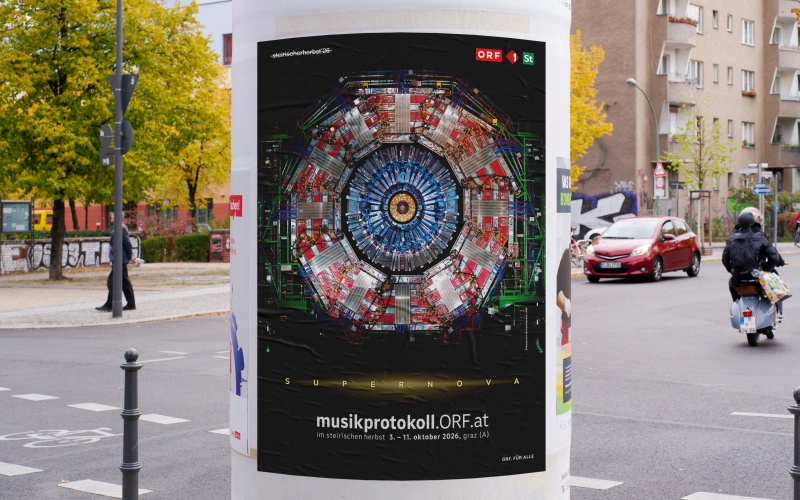
The theme of this year’s festival is the famous photograph of the CMS. The CMS (Compact Muon Solenoid) experiment is one of the four particle detectors at CERN’s Large Hadron Collider (LHC). CMS is 25 metres long, has a diameter of 20 metres and consists of eleven discs that can be slid apart.
In 2008, the physicist, photographer and artist Michael Hoch had the idea of taking a life-size photograph of one of these discs. As it turned out, this required 210 individual photographs, which were eventually stitched together. For a whole day, Hoch, together with a colleague, the CERN photographer Maximilien Brice, ‘scanned’ the surface of the disc in question, step by step, centimetre by centimetre, from top left to bottom right, with the aid of a lifting platform. As a result, even the cable labels are now legible.
This artistic photograph, composed of 210 individual images, offers a perspective that is otherwise impossible to achieve – namely a frontal view – and shows the CMS experiment in all its splendour. The circular and geometric arrangement of the individual elements in their many different colours around the beamline – which usually runs exactly through the centre – has already reminded viewers of the famous rose window at Notre-Dame Cathedral in Paris and of a mandala.
Michael Hoch has already exhibited it in numerous locations around the world as part of collaborations with art@CMS/ORIGIN, to give people a sense of the scale of this truly impressive scientific instrument, which very few people are actually able to visit. Since 2012, the art@CMS/ORIGIN outreach programme has been bringing together the scientific community associated with CMS and related institutions with artists, art students and art teachers, with the aim of inspiring as many people as possible to take an interest in particle physics.
At the joint invitation of ORF musikprotokoll and steirischer herbst, a group of lecturers, researchers and students from the University of Music and Performing Arts Graz and the University of Graz travelled in January 2026 to the SciArt Dialogue Week 2026, organised by art@CMS/ORIGIN. The resulting artworks and theoretical insights will be presented as part of the ‘Supernova’ exhibition at the Museum of Folk Life and the symposium ‘Space, Time and Material: Trajectories between Art and Science’ at the Meerscheinschlössl during this year’s musikprotokoll.
Throughout the festival, the section of the photograph in question showing the centrepiece of the CMS Experiment will be on display on the wall in front of the Volkskundemuseum.