6.-8.10.2026
How can the insights and data obtained through physical research processes — which we often cannot immediately perceive with our senses — be translated into musical and audiovisual forms and dramaturgies? What concepts of time do the sciences and the arts pursue in their explorations of the micro- and macrocosm? What conceptions of space do they develop? What questions drive their respective research and experiments? How do they generate and handle their material? What words and narratives do scientists and artists use in attempting to describe, share, and discuss their experiences and perceptions?
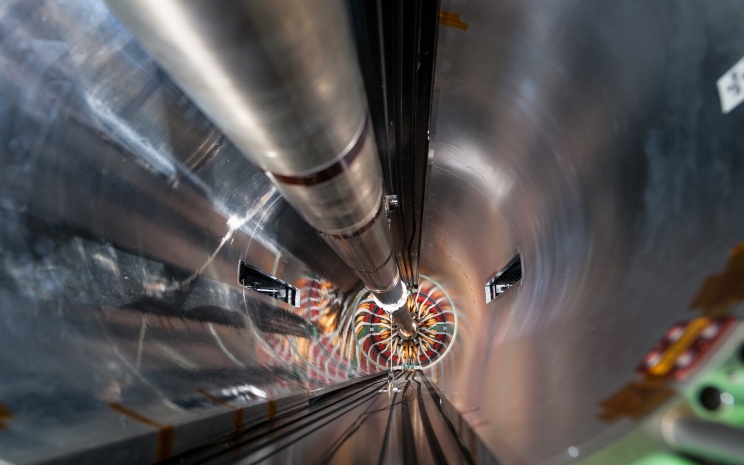
These are some of the questions that will be discussed at the interdisciplinary symposium “Space, Time, and Material: Trajectories between Art and Science”. The initial spark was a field trip to the SciArt Dialogue Week 2026 at CERN, in which eight teachers, researchers, and students from the fields of musicology, art history, philosophy, physics, and religious studies at the University of Graz participated. The inspiring dialogue begun there is now continued in Graz. Scientists who conduct research at CERN also travel to take part.
In the workshop What Does “Thinking Outside the Box” Really Mean?, Pablo Garcia Tello, head of CERN IdeaSquare, will show ways of escaping entrenched patterns of thought.
Speakers: Julian Blunk (University of Graz), Chris Henschke (RMIT University), Michael Hoch (KIT Karlsruhe Institute of Technology, CERN), Joep Janssens (University of Graz), Susanne Kogler (University of Graz), Raphaela Miklauc (University of Graz), Niklas Notter (University of Graz), Silvia Pisano (CERN), Harrison B. Prosper (Florida State University, CERN), Rafał Ryterski (Warsaw), Elisabeth Schimana (Vienna), Lioba Strieder (University of Graz), Pablo Garcia Tello (IdeaSquare CERN), Georg Wieland (University of Graz), Franz Winter (University of Graz)
Concept, organisation: Susanne Kogler
Idea, concept, journalistic accompaniment: Susanna Niedermayr
Space, Time and Material: Trajectories between Art and Science
A project of the University of Graz (Department of Arts and Musicology and interdisciplinary core research area “Perception: Episteme, Aesthetics, Politics” at the Faculty of Humanities). In cooperation with ORF musikprotokoll, art@CMS/ORIGIN, CERN – European Organization for Nuclear Research (with the experiments ATLAS – A Toroidal LHC ApparatuS, ALICE – A Large Ion Collider Experiment, CMS – Compact Muon Solenoid, LHCb – Large Hadron Collider beauty, and IdeaSquare – Innovation Space at CERN), University of Music and Performing Arts Graz (Institute 11 Stage Design), Florida State University, RMIT University.
What Does “Thinking Outside the Box” Really Mean?, 8.10., 9:00 – register now